In the days before there was a “New route 13,” all westbound vehicle traffic left Marion by way of a two-laned paved road we now call “Old 13.”
Where this Route 13 was intersected by Route 148, which came south from Herrin, the westbound road split in two. One lane veered off toward the north in a curving path shaped somewhat like the letter “Y.” This type of interchange was therefore commonly known as “the wye.”
South of this wye, the sprawling and secret Illinois Ordnance Plant was built. The plant manufactured ammunition for the Allies during World War II. The route 13/148 intersection was its main entrance. Older residents can still remember the security police gatehouse and barriers standing across the road there, during the 1940’s.
Today, the ammunition factory grounds, once known as “Ordill,” have been incorporated into the Crab Orchard Wildlife Refuge.
Standing just beside Old 13, in the northeast part of this intersection, is a sprawling, ramshackle wooden building. Some say that the structure was originally built as a barbecue stand or a nightspot. But for the past 60 and more years, it has been the site of the Wye Supply.
A carpenter named Vince Cagle owned the place after World War II. He expanded the small building into much larger building supply and hardware store and created the board sided structure which we can see today.
It was Cagle who dubbed his store “The Wye Supply.” In 1954, Carl and Theresa “Tess” Hill bought the Wye Supply from the Cagle family. The Hill’s ran the store for 28 years. After Carl Hill died in 1978, Tess ran the store alone for a while, and then sold it to Carl McVey.
McVey and David Fogle were able to keep the Wye Supple open and operating, even as the Wal-Marts, Lowes, and Home Depot stores took over the public’s bargain buying role. Customers to this country-type store found dirt floors and dimly lit shelves filled with basic farm and home tools and supplies. It was a dependable source for those once common, but now seldom found items from the last century. The exploring shopper would often be rewarded by uncovering good deals on long stored items. This writer remembers finding a box of dusty glass chimneys for kerosene lamps sitting quietly on the floor there, maybe for decades, awaiting a buyer.
Nowadays, shoppers at the megastores can find plastic packed items hanging from hooks, prominently displayed in brightly lighted, heated and air conditioned emporiums. But they will never find the flavor or the fun of searching through the old Wye Supply. Perhaps that atmosphere is lost forever.
After Carl McVeys death in 1987, David Fogle continued to manage the store by himself. But the tired old structure drooped further and further, until a fire took part of the roof and destroyed much of its contents. David passed away in 2005, and the sagging building now sites forlornly, seemingly awaiting total collapse.
(Published in the Marion Living Magazine, July 2007 by Bernard A. Paul)
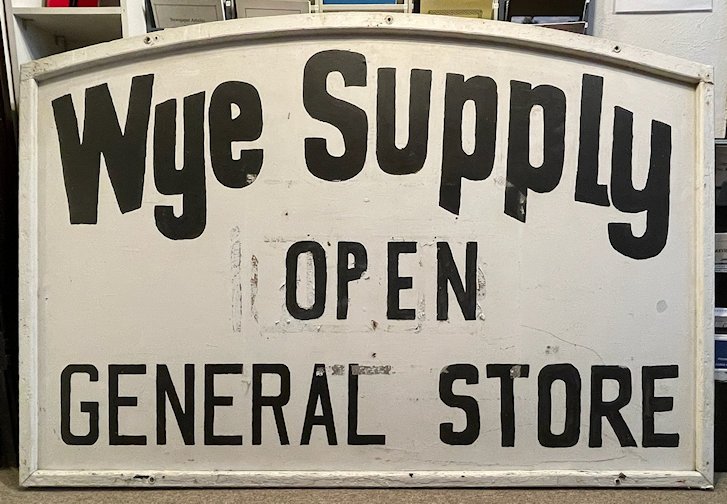
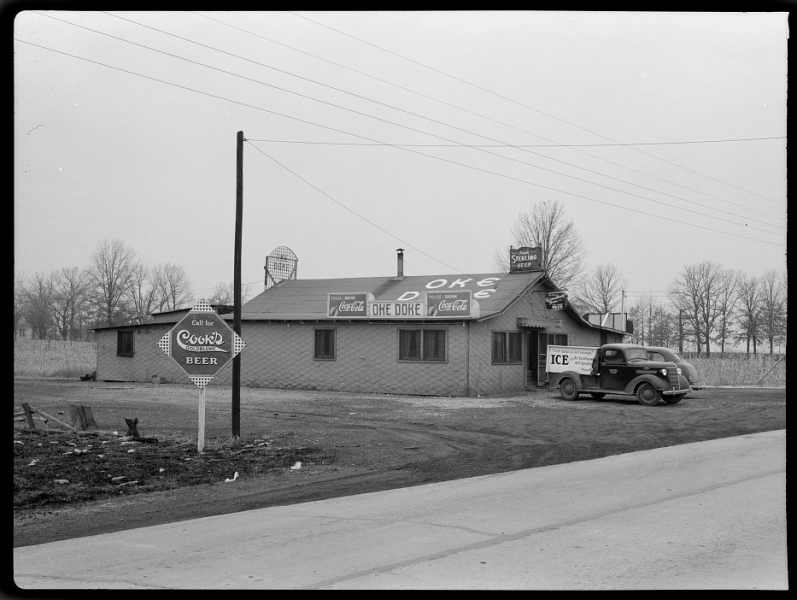
After this article was published in 2007, the old building had been demolished and removed by 2009. The Wye Supply is remembered as being one of the first larger discount warehouses in the area. I especially remember that they carried a selection of WWII army surplus goods and it’s hard to forget that the floors were so spongy it was at times like walking on a trampoline. In 1939, a Farm Security Administration photographer named Arthur Rothstein took a photo of a building on old Rt. 13 named the “Oke Doke Dance Hall” which is thought to be the original Wye Supply building. By the late 1950’s and 1960’s the Wye Supply ran into competition with other discount houses that went under the names “Cousin Fred’s” and “Grandpa John’s” which were fairly similar in content to Rural King today. After the building’s demise, the sign from the building somehow made its way to an antique store in Metropolis, Illinois. Around 2017, Marion resident, Edward Bridges, discovered the sign while shopping there with his wife and purchased the sign so it could be returned to Williamson County. Edward donated the sign to the Williamson county Historical Society’s museum on July 30th, 2026 where it will find a home in our second floor General Store display and live again.